
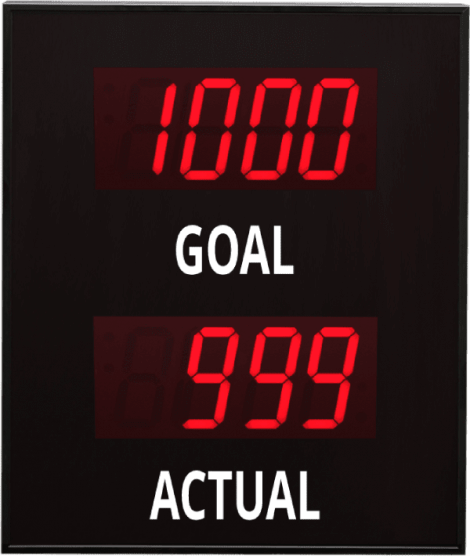
Salescaster® Goal & Actual LED Production Counters provide a clear, real-time comparison between production targets and actual output. Manufacturing personnel can monitor progress throughout a production shift using either a fixed production goal or an automatically advancing goal controlled by a TAKT pace timer. These displays help operators and supervisors quickly recognize when production is ahead of or behind the established target.
Actual production counts can increase or decrease in increments of one using a switchbox, switchplate, or compatible counting sensor. A wireless remote allows operators to configure a static production goal or the countdown pace timer. Salescaster® offers configurations for straightforward production counting as well as applications requiring additional production monitoring capabilities.
Related Production Display Solutions
For applications requiring automatically advancing production goals and countdown pacing, explore our TAKT Timers and LED Production Counters.
For applications requiring additional production information, multiple display fields, or broader factory-floor communication, explore our Industrial LED Production Displays.
For applications requiring equipment status information, production alerts, and requests for operator or maintenance assistance, explore our ANDON Boards.
For applications requiring broader production monitoring and downtime tracking, explore our Production Monitoring and Downtime Tracking solutions.
Understanding Fixed and Automatically Advancing Production Goals
Fixed Production Goal
A fixed production goal displays a predetermined target alongside the actual number of units produced. The goal remains unchanged until it is reset or reprogrammed, while the actual count increases or decreases as production progresses. This configuration is useful when operators and supervisors need to monitor progress toward an established production target.
Automatically Advancing Production Goal
An automatically advancing production goal uses a TAKT pace timer to increase the displayed goal count at programmed time intervals. As production continues, employees can compare actual output against the continuously advancing target to determine whether manufacturing is keeping pace with the planned production rate.
Which Configuration Is Right for Your Operation?
Choose a fixed production goal when your primary objective is to compare actual output against a predetermined production target.
Choose an automatically advancing goal when operators need to monitor production performance against a target that increases throughout the shift.
Salescaster® can help evaluate your production requirements and recommend the appropriate counting and pacing configuration.
Goal & Actual Production Counter Features
Display and Counting Features
- Count Up/Down: Actual production counts increase or decrease in increments of one.
- Goal Configuration: Display a fixed production target or an automatically advancing goal using a TAKT pace timer.
- Counting Configurations: Two-digit and four-digit configurations available.
- LED Digit Sizes: Bright red, two-line displays with standard 4-inch digits; 2.5-inch and 7-inch digit sizes also available.
- Cabinet Construction: Anodized aluminum frame with a protective, non-glare lens.
- Battery Backup: Lithium battery backup preserves stored data during a power interruption.
Control and Sensor Options
- Count Inputs: Switchbox or relay-closure inputs for updating actual production counts.
- Wireless Remote Control: Configure production goals or pace timer settings.
- Synchronization Options: Available relay-based synchronization or connections with compatible production counter displays.
- Automatic Counting Sensors: Optional photoelectric diffuse or proximity sensors for detecting products and updating counts.
Photoelectric IR Sensors
Photoelectric infrared (IR) sensors provide automatic production counting by detecting products or materials as they pass a designated sensing point. When properly configured, these sensors generate counting signals that can update the actual production count on compatible Salescaster® Goal & Actual Production Counters.
Common photoelectric sensing methods include:
- Through-Beam Sensors: Use a separate transmitter and receiver. An object is detected when it interrupts the light beam between them.
- Retro-Reflective Sensors: Use a transmitter and receiver in one housing with a separate reflector. An object is detected when it interrupts the reflected beam.
- Diffuse-Reflective Sensors: Detect light reflected directly from the object, eliminating the need for a separate reflector.
The appropriate sensor depends on the product’s size, material, surface characteristics, sensing distance, and installation environment. Electrical output compatibility and the production counter’s input requirements should also be confirmed before selecting a sensor.
Proximity Sensors
Proximity sensors provide automatic production counting by detecting objects without physical contact. When properly configured, compatible sensors can generate signals that update the actual production count on Salescaster® Goal & Actual LED Production Counters.
Two common proximity sensing technologies include:
- Inductive Proximity Sensors: Detect metallic objects using an electromagnetic field. These sensors are commonly used to count metal components, machine parts, and other conductive materials in manufacturing applications.
- Capacitive Proximity Sensors: Detect changes in capacitance caused by nearby objects. Depending on the sensor and application, they can detect metallic and certain nonmetallic materials, including plastics, glass, and some liquids.
Sensor selection depends on the material being detected, sensing distance, operating environment, and required electrical output. Compatibility with the production counter’s counting inputs should be confirmed before installation.
Goal & Actual Production Counter FAQs
How is the actual production count updated?
Depending on the selected configuration, the actual production count can increase or decrease in increments of one using a switchbox or relay-closure input. Compatible photoelectric or proximity sensors may also provide automatic counting signals as products pass a sensing point. Sensor compatibility should be confirmed for each application.
Can the display show a goal alongside actual output?
Yes. Salescaster® Goal & Actual Production Counters can display actual production output alongside a fixed production goal or an automatically advancing goal controlled by a TAKT pace timer. A fixed goal remains constant until changed, while an automatically advancing goal increases at programmed intervals to reflect the planned production rate.
What digit sizes and counting formats are available?
Salescaster® Goal & Actual Production Counters are available in two-digit and four-digit counting configurations. Standard displays feature bright red, 4-inch-high LED digits, with 2.5-inch and 7-inch digit sizes also available. Contact Salescaster® to confirm the appropriate configuration for your application.
The Salescaster® Advantage
Salescaster® has provided visual communication solutions since 1950. Our industrial LED production counters help manufacturing personnel monitor production goals, actual output, and progress throughout the workday.
We assist customers in selecting the appropriate Goal & Actual Production Counter configuration for their manufacturing requirements. Available options include manual counting inputs, compatible photoelectric or proximity sensors, fixed production goals, and automatically advancing goals controlled by TAKT pace timers.
Whether your application requires straightforward production counting or integration with existing manufacturing equipment, Salescaster® can help evaluate display configurations, counting methods, and electrical compatibility.
Contact Salescaster® to discuss your application and request a quotation for an appropriate production counting solution.